
Is AI good for creatives?
✨ Watch on YouTube or listen on Apple Podcasts or Spotify.
Twenty years ago, making a feature film cost millions of dollars a day. Today, the two biggest films at the box office – Obsession and Backrooms – were made by YouTube creators. Could AI be making the process of creativity more accessible?
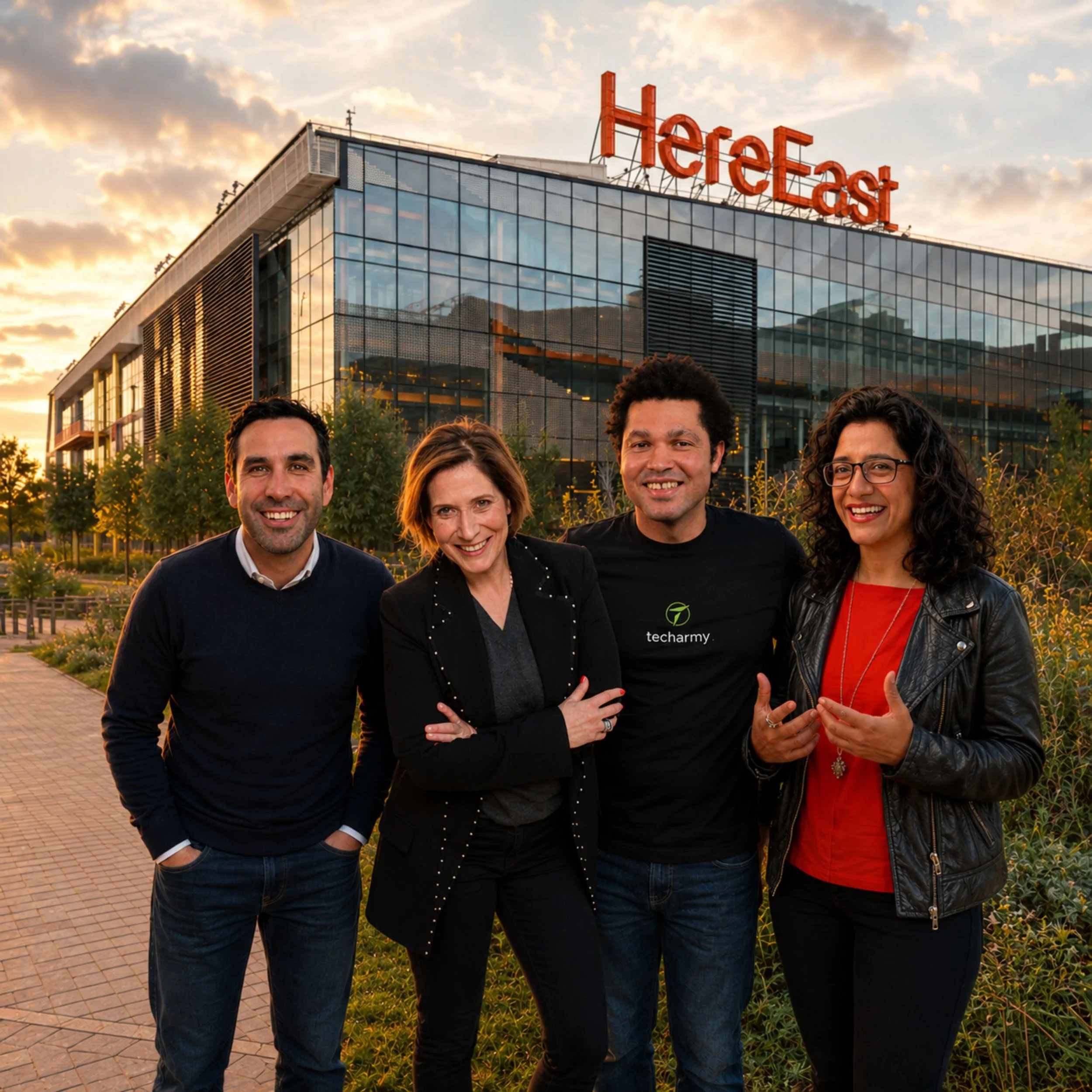
Recorded live at Here East during SXSW London, this special edition of Visionary asks whether the tools now reshaping film, music, design and motion capture are genuinely opening the creative world to more people — or simply generating an overwhelming amount of noise.
London sits at the centre of this transformation, home to 78% of the UK's AI and data-driven creative technology companies. But having the tools and knowing what to do with them are very different things.
Georgina Godwin chairs a conversation with Justin Diener, founder of Synapse Virtual Production, whose LED wall studios are rewriting the economics of film and immersive media; Usha Raghavachari, Lab Director for Ford's Human Centred Design team, who still uses cardboard, clay and ethnographic observation alongside oceans of connected vehicle data; and Allan Rankin, co-founder of Target 3D, whose motion capture technology is being transformed by AI tools that can animate multiple characters in hours rather than weeks.
Together they make a compelling case that the creative breakthrough AI enables is real — but that domain expertise, human taste and the mysterious alchemy of lightbulb moments in the shower still matter more than any prompt. The deeper worry, they agree, isn't the tools themselves. It's who owns the platforms those tools run on, and what happens when access becomes something only some people can afford.
In this episode, you’ll learn:
AI democratises access but not quality. The barrier to making something has never been lower — but without genuine creative expertise and domain knowledge, the result is noise. The tools amplify talent; they don't replace it.
The greatest risk isn't what AI can do, but who controls the infrastructure it runs on. As a handful of tech giants consolidate ownership of these systems, the question of who gets access — and on what terms — becomes an urgent equity issue.
Human creativity still has an edge AI can't replicate. Whether it's Ford's designers still building clay car models by hand, or the moment of synthesis that happens in the shower rather than the brainstorm, the panellists are clear: the empathy, instinct and connective thinking that produce genuine creative breakthroughs remain stubbornly, reassuringly human.
Watch the episode on YouTube below, or listen via your preferred podcast app.
